
The “Filler Fatigue” Phenomenon
Let’s talk about what usually happens before someone walks into my office for a surgical consult. By the time you hit 42 or 45, you’ve probably noticed some changes. Maybe the jawline isn’t as crisp as it was at 30. Maybe the nasolabial folds (smile lines) are deepening.
The first line of defense is almost always injectables. And don’t get me wrong—I love fillers. When used correctly to replace lost volume, they are magic.
But here is the trap: Fillers are meant to fill, not to lift.
In our 40s, the primary issue often isn’t just volume loss; it’s gravity. The ligaments holding our facial tissues in place start to loosen, and the fat pads in our cheeks begin to slide down. If we try to “lift” that falling tissue by pumping more and more filler into the cheeks or jawline, we end up with that puffy, over-filled look often called “pillow face” or “filler fatigue.”
You walk around looking smooth, yes, but you might lose the definition that makes you look like you.
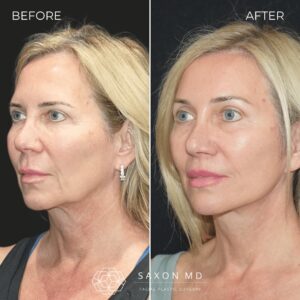
This is where the deep plane facelift comes in. It solves the structural problem (gravity and laxity) so we don’t have to overcompensate with volume. It allows us to reset the clock physically, rather than just camouflaging the time.
The “Ozempic Face” Reality: When Weight Loss Ages You
There is another massive driver for surgery in the 40s right now, and we need to talk about it openly: GLP-1 agonists.
Whether it is Ozempic, Mounjaro, or Wegovy, these medications have been life-changing for millions of people struggling with weight. I have patients who have lost 30, 40, or 50 pounds and feel healthier and more energetic than they have in years. That is something to celebrate.
But there is a paradoxical side effect often dubbed “Ozempic Face.”
When you lose a significant amount of weight rapidly in your 40s, your skin doesn’t snap back the way it might have in your 20s. Facial fat is actually a pillar of youth—it props up our skin. When that fat melts away quickly, two things happen:
Volume Deflation: You lose the “cushion” in your cheeks and temples, which can make you look gaunt or hollow.
Structural Descent: Without that volume to prop it up, the skin and underlying muscle (SMAS) succumb to gravity much faster.
I am seeing beautiful, fit women in their 40s who have reached their goal weight but feel like their face aged 10 years in the process. They see loose skin on the neck and jowling that wasn’t there six months ago.
For these patients, non-surgical options are almost always a disappointment. You cannot “exercise” the skin back into place, and adding filler to a face that is already sagging due to weight loss can look heavy and unnatural. A deep plane facelift is often the only way to re-drape that loose skin and restore the youthful, heart-shaped contour that was lost along with the weight.
The “Non-Surgical Merry-Go-Round”
If you are reading this, there is a good chance you have already tried to fix these issues without surgery. You aren’t alone. Most of my patients in their 40s have spent years—and a small fortune—on the “non-invasive” circuit before they find their way to me.
We live in a golden age of med-spa marketing. You are promised that a machine, a laser, or a thread can give you a “facelift-like result” with zero downtime. It sounds incredibly appealing. Who wouldn’t want that?
But let’s look at the reality of three common treatments:
1. PDO Threads: Threads are marketed as a “lunchtime lift.” The idea is to insert dissolvable sutures under the skin to pull it back. While this can provide a temporary improvement for very mild laxity, it is purely mechanical. It doesn’t release the ligaments that are tethering your face down. The result? It often looks good for about three months. Then, the threads dissolve, or the tissues slip back, and you are back to square one. Worse, repetitive threading can create scar tissue (fibrosis) under the skin that makes future surgery more difficult.
2. RF Microneedling (e.g., Morpheus8): I use these devices for skin quality—texture, pore size, and fine lines. They are fantastic for that. But marketing them as a tool to “lift” sagging jowls is misleading. If you have true descent of the cheek fat pad, heating the skin isn’t going to move it back up. In fact, if these energy devices are used too aggressively in an attempt to tighten, they can actually melt precious facial fat, worsening the aging process.
3. Ultrasound (Ultherapy, Sofwave, etc.): Similar to RF, these treat the skin, not the structure. They can offer mild tightening, but they cannot reposition the muscle.
The frustration I hear from patients is palpable. They say, “Dr. Saxon, I’ve spent $15,000 over the last three years on threads and lasers, and I look exactly the same.”
This is the “sunk cost” of avoiding surgery. Optimizing for a deep plane facelift in your 40s allows you to skip this expensive, frustrating middle stage. Instead of renting a result for three months, you are investing in a result that lasts a decade or more.
Why the Deep Plane Technique is Different
If the word “facelift” still conjures up images of windblown, tight skin or pulled mouths, I want you to delete that mental image. That is the ghost of facelifts past!
Those “tight” looks happened because older techniques (like the traditional SMAS lift) relied heavily on pulling the skin itself to create tension.
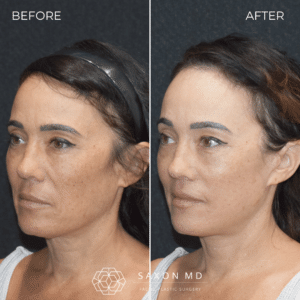
The deep plane facelift is entirely different. As a surgeon who views this work through an artistic lens, this is my preferred technique because it is anatomically correct. Instead of separating the skin from the muscle and pulling them tightly against each other, we go deeper. We release the ligaments that tether the facial tissues down.
Think of it like making a bed. If the sheets (your skin) are wrinkled because the mattress pad (your muscle/fat) underneath is bunched up, pulling the sheet tighter only works for a second and looks strained. The deep plane technique smooths out the mattress pad itself. We lift the muscle and skin together as one composite unit.
Because there is no tension on the skin, there is no “pulled” look. Your ears don’t look strange. Your smile looks natural. You just look like a refreshed version of yourself—like you’ve had the best month of sleep of your life.
The “40s Advantage”: Why Do It Now?
So, why not wait until 60? There are a few compelling reasons why doing this in your 40s is gaining popularity:
1. Better Tissue Quality = Better Results:
In your 40s, your skin still has excellent elasticity and collagen support. When we perform surgery on healthier, younger tissue, it heals faster and settles more smoothly. The “snap back” is better.
2. The “Invisible” Transformation:
When you wait until your late 60s or 70s to have a facelift, the change is drastic. You might look 15 or 20 years younger overnight, which is wonderful, but it’s undeniably obvious to everyone around you.
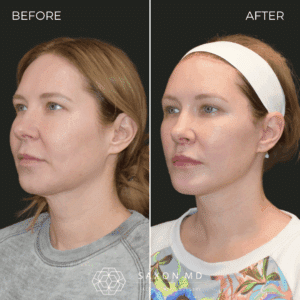
When you have a deep plane facelift in your 40s, the transition is subtle. You aren’t trying to reverse 30 years of aging; you’re just resetting the clock by about 10 years. People tend to notice you look great—rested, vibrant, fit—but they can rarely pinpoint that you’ve “had work done.” It preserves your identity while maintaining your youth.
3. “Prejuvenation” and Longevity:
Think of this as maintenance rather than repair. If we address the laxity early, you get to enjoy that youthful jawline and neck for the next 10 to 15 years (or more) during the prime of your life. You get to enjoy your 40s and 50s feeling confident, rather than spending those decades worrying about your neck in photos.
Is it “Too Aggressive”?
I hear this concern a lot. Is surgery too aggressive for a 45-year-old?
It’s a valid question. Surgery is a big decision. However, I would argue that chasing a lifting result with non-surgical devices that don’t quite deliver, or over-using fillers for a decade, can sometimes be more detrimental to your long-term aesthetic than a single, precise surgical intervention.
A deep plane facelift in your 40s is often less invasive in terms of the amount of skin removed and the trauma to the tissue because the correction needed is smaller.
Let’s Chat
If you are finding yourself holding back the skin on your jawline in the mirror, or if you feel like your face is starting to look heavy despite your best efforts with skincare and injectables, it might be time to just have the conversation.
We can look at your anatomy, talk about your goals, and see if a deep plane facelift is the right step for you. It’s not about vanity; it’s about alignment—making sure the face you see in the mirror matches the energy you feel inside.
You May Also Like:
- Ponytail Facelift vs Deep Plane Facelift: Which Is Right For You?
- Fine Lines vs Deep Rhytids: How to Treat Each Effectively
- How to Maintain Facelift Results With Nonsurgical Treatments
- Combining Lower Facelift and Neck Lift: When Is It Needed?
- How Much Does a Facelift Cost?
- Deep Plane Facelift Before and After Gallery