
First, What Is the SMAS?
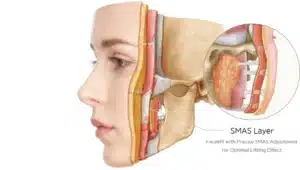
The SMAS stands for the superficial musculoaponeurotic system. That sounds complicated, but it is simply a layer of connective tissue and muscle beneath the skin and fat of the face. It extends from the neck into the lower face and cheeks, and it plays an important role in facial structure.
When the face ages, the skin is not the only thing that changes. The deeper support layers also descend. This is why patients develop jowls, heaviness along the jawline, deeper folds around the mouth, and laxity in the neck.
Older facelift techniques focused mostly on tightening the skin. That approach could improve loose skin temporarily, but it often created a pulled or windswept appearance because the deeper structures were not adequately repositioned. Modern facelift surgery is different. Today, most high-quality facelift techniques address the SMAS in some way because the SMAS is a stronger and more meaningful support layer than the skin alone.
The real question is not whether the SMAS should be lifted. In most modern facelifts, it should be. The better question is how the SMAS is lifted and whether the tissues that are tethering the face downward are released.
What People Usually Mean by a SMAS Facelift
The term “SMAS facelift” can be confusing because it is used in different ways. Technically, a deep plane facelift also involves the SMAS, so it could be considered part of the larger family of SMAS-based facelifts. However, when most people compare a deep plane vs SMAS facelift, they are usually referring to a more traditional SMAS technique.
In a traditional SMAS facelift, the skin is lifted away from the underlying SMAS layer. Once the skin has been separated, the surgeon tightens the SMAS using sutures, excision, overlap, or a combination of techniques. The skin is then redraped and closed with less tension than would be used in a skin-only facelift.
This can be a very effective operation, especially for patients with mild to moderate aging changes. The important detail is that the skin and SMAS are usually treated as separate layers. That is different from a deep plane facelift, where the skin, fat, and SMAS are repositioned together as a more unified layer after key retaining ligaments are released.
SMAS Plication
When most patients hear the term “SMAS facelift,” they are often surprised to learn that there are several different ways to lift the SMAS. One of the most common is SMAS plication.
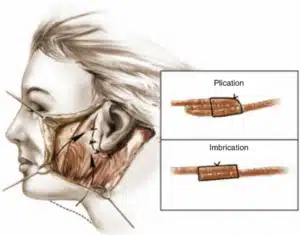
With SMAS plication, the surgeon folds and tightens the SMAS with sutures. The SMAS is not usually cut or removed. Instead, it is gathered and secured, almost like creating a pleat in fabric.
This technique can be useful for patients who have early facial aging, mild jowling, or less significant tissue descent. It typically involves less dissection than more aggressive facelift techniques and can provide a nice improvement in the jawline and lower face.
The limitation is that plication does not release the retaining ligaments of the face. These ligaments act like anchors. They hold the soft tissues in place, which is helpful when we are young, but as the face ages, those same tethering points can limit how much the tissues can be repositioned. If the ligaments are not released, the surgeon can tighten the SMAS, but the deeper facial tissues may not move as freely.
This is one reason SMAS plication may be less effective for patients with more advanced midface descent, deeper nasolabial folds, or heavier jowling.
SMAS Imbrication
SMAS imbrication is a stronger form of SMAS manipulation than plication. Instead of simply folding the SMAS, the surgeon cuts, overlaps, or removes a portion of it before securing the tissue in a lifted position. Some surgeons refer to related techniques as SMASectomy or SMAS ligation, depending on exactly how the tissue is handled.
The practical difference is that imbrication usually creates a more powerful lift than plication. It can improve the lower face, sharpen the jawline, and provide better support in the neck and jowl region. For many patients, this can be a very worthwhile approach.
However, SMAS imbrication still typically involves separating the skin from the SMAS and then tightening the SMAS as its own layer. The deeper facial retaining ligaments are not released in the same way they are during a deep plane facelift. Because of that, the lift is still limited by the tethering points of the face.
This does not mean SMAS imbrication is ineffective. A well-done SMAS imbrication facelift can look excellent. It simply means the technique works through tightening and repositioning the SMAS rather than fully mobilizing the deeper facial soft tissues as a composite unit.
SMAS Plication vs SMAS Imbrication
I think it is helpful to separate these two because many articles group them together under the broad label of “SMAS facelift.” They are related, but they are not identical.
SMAS plication folds the SMAS with sutures. It is generally more conservative and works best when the aging changes are mild.
SMAS imbrication cuts, overlaps, or removes a portion of the SMAS before securing it. It is typically more powerful and may provide better correction of jowls and neck laxity.
Both approaches can be useful. The main limitation is that neither one releases the facial retaining ligaments to the same extent as a deep plane facelift. That difference becomes especially important when patients want improvement in the cheeks, nasolabial folds, and deeper facial descent rather than just tightening along the jawline.
What Is a Deep Plane Facelift?
A deep plane facelift takes a different approach. Instead of separating the skin from the SMAS and tightening the SMAS separately, the surgeon works beneath the SMAS in a deeper anatomical plane.
The major distinction is ligament release. The face has retaining ligaments that attach the soft tissues to deeper structures. As the face ages, the cheeks, jowls, and lower face descend around these tethering points. If those ligaments are not released, the surgeon can pull on the tissues, but the movement is restricted.
During a deep plane facelift, these ligaments are carefully released so the facial tissues can be repositioned more completely. The skin, fat, and SMAS move together as a composite unit rather than being pulled in separate layers.
This is one of the reasons deep plane facelifts can look so natural. The goal is not to stretch the skin tighter. The goal is to restore the deeper facial tissues closer to where they used to be.

Why Ligament Release Matters
In my opinion, ligament release is one of the most important differences in the deep plane vs SMAS facelift discussion. Almost every modern facelift addresses the SMAS in some way. The bigger question is whether the surgeon is simply tightening the SMAS or actually releasing the structures that prevent the face from moving back into a more youthful position.
I often explain this to patients with a simple analogy. Imagine trying to pull a curtain while parts of it are still hooked to the wall. You can create some movement, but the hooks limit how far the curtain can go. The retaining ligaments of the face work in a similar way.
When those ligaments are released carefully, the surgeon can reposition the cheeks, jowls, and lower face with less reliance on pulling. That is why deep plane techniques often create a more meaningful improvement in the midface and nasolabial folds compared with traditional SMAS techniques.
This is also where artistry matters. The goal is not to over-release or over-lift. The goal is to restore facial shape in a way that looks balanced, natural, and appropriate for the patient’s anatomy.
Deep Plane vs SMAS Facelift: Where the Results Show Up
Traditional SMAS techniques tend to create their strongest improvement in the lower face and neck. Patients may see better jawline definition, reduced jowling, and a cleaner transition from the face into the neck.
A deep plane facelift can also improve the lower face and neck, but it tends to offer more correction in the cheek and midface. Because the cheek fat pads are repositioned with the deeper tissues, patients often see a more youthful cheek contour and a softer transition around the nasolabial folds.
This distinction matters because many patients do not come in saying, “I want my SMAS lifted.” They come in saying they look tired, heavy, or older than they feel. They notice their cheeks have dropped, their jawline has softened, and the lower face looks heavier in photos.
For patients with significant midface descent, a traditional SMAS technique may improve the jawline but leave some of the central facial aging less corrected. A deep plane facelift is designed to address that deeper descent more directly.

Which Technique Looks More Natural?
A natural result depends more on the surgeon than the name of the technique. I think this point gets lost online. A beautifully performed SMAS facelift can look much better than a poorly performed deep plane facelift. Technique matters, but execution matters more.
That said, the deep plane approach has some built-in advantages when it is done well. Because the deeper tissues are repositioned as a unit, less tension is placed on the skin closure. The skin is redraped rather than used as the main lifting structure.
That distinction is important. The overly tight facelift look that patients worry about usually comes from too much tension on the skin or from lifting in a direction that does not match natural facial anatomy. When the deeper tissues are restored properly, the skin does not have to do all the work.
The result should not look like a different person. It should look like a rested, more refreshed version of the same person.
The Problem With the Deep Plane vs SMAS Debate
The internet has made the deep plane vs SMAS facelift debate more confusing than it needs to be. Some marketing makes it sound like every deep plane facelift is automatically superior and every SMAS facelift is outdated. I do not think that is a fair or accurate way to look at it.
A facelift is not good just because someone calls it deep plane. It is good when the operation is planned well, performed safely, and tailored to the patient’s anatomy. The surgeon’s experience, judgment, and ability to create a natural result are all critical.
At the same time, I do think deep plane facelifts offer real anatomical advantages, particularly for patients with noticeable cheek descent, jowling, and heavier lower facial aging. That is why I use deep plane techniques in my own practice. I like that the procedure allows me to correct the underlying descent rather than simply tighten tissue that has already fallen.
Recovery After Deep Plane vs SMAS Facelift
Many patients assume that because a deep plane facelift sounds “deeper,” the recovery must be much harder. That is not always the case.
Traditional SMAS facelifts often require a wider separation of the skin from the underlying tissues. That skin flap then has to heal back down. In a deep plane facelift, more of the natural connection between the skin and deeper tissues can be preserved, depending on the exact technique used. This may help support blood supply and healing.
That does not mean recovery is effortless. Any facelift involves swelling, bruising, tightness, and a period of looking and feeling like you have had surgery. Most patients need about two to three weeks before they feel comfortable returning to many social activities. Swelling continues to improve over several months, and the final result becomes more refined with time.
In my experience, recovery depends less on whether the facelift is labeled SMAS or deep plane and more on the extent of surgery, the patient’s anatomy, surgical technique, and how well the patient follows postoperative instructions.
Does a Deep Plane Facelift Last Longer Than a SMAS Facelift?
This is one of the most common questions patients ask, and it is a reasonable one. Facelift surgery is a major investment, and patients want to know how long their results are likely to last.
The honest answer is that no facelift lasts forever. Surgery can reposition aging tissues, but it cannot stop the aging process. Skin quality, genetics, sun exposure, weight changes, smoking history, and overall health all influence how the face ages after surgery.
Traditional SMAS facelifts can last many years, often around 8 to 12 years or longer in the right patient. SMAS imbrication generally provides more structural support than plication, so it may be more durable than a simple plication technique.
Deep plane facelifts may offer a longevity advantage because they reposition the deeper facial tissues closer to their original anatomical position. Instead of relying mainly on tightening, the procedure releases the retaining ligaments and restores the facial soft tissues more completely.
One of the reasons I have gravitated toward deep plane techniques is that I want the result to age gracefully. While patients will continue to age, I believe starting from a more anatomically restored position gives the face a stronger foundation over time.
Why Not Every Surgeon Performs Deep Plane Facelifts
Deep plane facelift surgery is technically demanding. It requires detailed knowledge of facial anatomy, careful dissection, and comfort working around the facial nerve branches. There is a learning curve, and not every surgeon chooses to perform this operation regularly.
This is one reason patients should look beyond the terminology on a website. Ask how often the surgeon performs facelifts. Look at before-and-after photos. Pay attention to whether the results look natural and consistent. During consultation, ask what technique the surgeon recommends for your anatomy and why.
The “why” matters. A surgeon should be able to explain their approach clearly without relying on vague marketing language.
How to Choose Your Surgeon — Not Just Your Technique
With a deep plane facelift especially, the surgeon matters as much as the method. This is advanced surgery, and experience shows in the result. When you consult, it’s fair to ask how often the surgeon performs the procedure, to look at before-and-after results, and to listen for whether they’re tailoring the recommendation to you or selling a single approach to everyone.
A facial plastic surgeon who specializes in the face — rather than treating facelifts as one offering among many across the body — brings a focused depth of experience to exactly this kind of decision. Use your consultation to prepare; the consultation guide covers what to bring and what to ask.
FAQ
Is a deep plane facelift better than a SMAS facelift?
Neither is universally “better.” The deep plane technique repositions deeper tissue and often produces a very natural, longer-lasting result, but the right choice depends on your anatomy and goals. The best approach is determined during your consultation.
Does a deep plane facelift last longer?
Because it repositions deeper structures rather than relying on skin tension, a deep plane facelift generally supports a long-lasting result. Aging continues naturally for everyone, so longevity also depends on factors like genetics and skin care.
Will a facelift look obvious or “pulled”?
A natural result comes from repositioning tissue correctly rather than over-tightening skin — one of the reasons the deep plane technique is valued. Surgeon experience is the biggest factor in avoiding an operated look.
How do I know which facelift I need?
You’ll know after an in-person evaluation. Your surgeon assesses your skin, your deeper tissue laxity, your facial structure, and your goals, then recommends the technique that fits you.
Ready to Learn Which Facelift Technique Is Right for You?
If you are considering facelift surgery, the best next step is to schedule a personalized consultation. During your visit, Dr. Sarah Saxon can evaluate your facial anatomy, discuss your goals, and explain whether a deep plane facelift, SMAS-based facelift, neck lift, or another approach would be most appropriate for you.
The goal is not to make you look different. The goal is to help you look refreshed, natural, and more like yourself again.
You May Also Like:

